
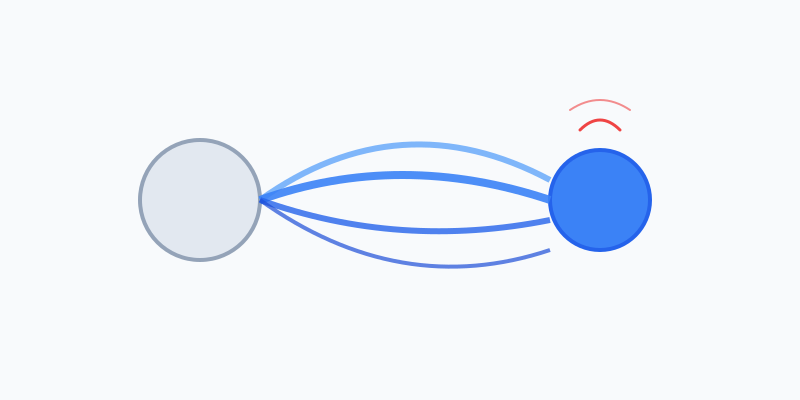
The Hyper-Activated Nervous System
Individuals with an Anxious Attachment style (sometimes referred to as Anxious-Preoccupied) navigate intimate relationships with a heightened sensitivity to potential threats. While an avoidant partner views closeness as a threat to autonomy, the anxiously attached individual views distance as a profound threat to their emotional survival. This dynamic often leads to what clinicians call "hyper-activation" of the attachment system.
This attachment style typically originates in childhoods characterized by inconsistent parenting. When a caregiver is sometimes warm and responsive, but other times cold, absent, or intrusive, the child learns that love is available but highly unreliable. The child adopts a strategy of hyper-vigilance, constantly monitoring the caregiver's mood and clinging tightly to ensure their needs are met.
The Anatomy of Protest Behavior
When the attachment system is triggered—perhaps by a partner's sudden quietness or a perceived slight—the anxious individual experiences intense physiological distress. To alleviate this anxiety and re-establish connection, they often engage in "protest behaviors." These are actions designed to force a response from the partner, often appearing irrational or manipulative to an outside observer.
Common Protest Behaviors:
- Excessive Contact: Calling or texting repeatedly until a response is received, overwhelming the partner.
- Keeping Score: Tracking exactly how long a partner takes to reply and waiting precisely that long to respond in return.
- Acting Out/Withdrawing: Pretending to be busy or ignoring the partner as a way to force the partner to "chase" them and prove their affection.
- Threatening to Leave: Using the threat of a breakup as a mechanism to test the partner's commitment (e.g., "If you don't care, maybe we shouldn't be together").
The tragedy of protest behavior is its inherent counter-productivity. The anxious individual acts out because they desperately need reassurance and closeness. However, these behaviors often overwhelm or irritate their partner (especially an avoidant one), causing the partner to pull away further—thus validating the anxious individual's deepest fears.
Anxious Attachment in Ethical Non-Monogamy
Entering Ethical Non-Monogamy (ENM) or Polyamory can be a crucible for anxiously attached individuals. The introduction of metamours and shared time requires a robust capacity for self-soothing. When a partner is out on a date, the anxious mind may spiral into catastrophic comparisons.
However, many clinicians argue that ENM can actually facilitate healing for anxious individuals if navigated with radical honesty. It forces the individual to confront the reality that a partner's affection for someone else does not diminish their love for the primary partner. Learning to experience Compersion—joy in a partner's joy—is a powerful antidote to scarcity-based anxiety.
Healing and Self-Soothing (Moving Toward Secure)
Like all attachment styles, anxiety is malleable. The journey toward "earned security" requires the anxious individual to build the self-soothing mechanisms they were not taught in childhood.
"Security is not finding a partner who never triggers you; it is developing the internal capacity to regulate yourself when triggered."
The first step is recognizing the physiological signs of hyper-activation (racing heart, obsessive thoughts). When these occur, the individual must learn to insert a "pause" before engaging in protest behavior. In this pause, cognitive reframing is essential: replacing "They are ignoring me because they don't love me" with "They are at work and will reply when they can."
Further Reading & Clinical Resources
To deepen your understanding of how attachment styles dictate relationship health, consider utilizing the following tools and articles:
- Take the Assessment: Confirm your baseline attachment style with our interactive clinical quiz.
- Risk Analysis: Understand how anxiety can masquerade as intuition.
- Seek Professional Counseling: Find a licensed therapist via BetterHelp to work through attachment trauma.
Understanding these psychological frameworks is the key to breaking toxic cycles and establishing secure, lasting connections.
Support the Research
Direct funding ensures continued fidelity. Support the Cheating Psychology Research Initiative.