The Geometry of Love
Polyamory is not a one-size-fits-all model. It is a customizable framework that can take many shapes—quite literally. In the poly community, relationship structures are often described using geometric terms like "Vees," "Triads," "Quads," and "Polycules." Understanding these structures is essential for defining boundaries and expectations.
When you enter a polyamorous dynamic, you are not just dating a person; you are entering a network. Who is connected to whom? How much time and energy does each connection receive? Let's break down the most common configurations.
1. The V-Structure (Vee)
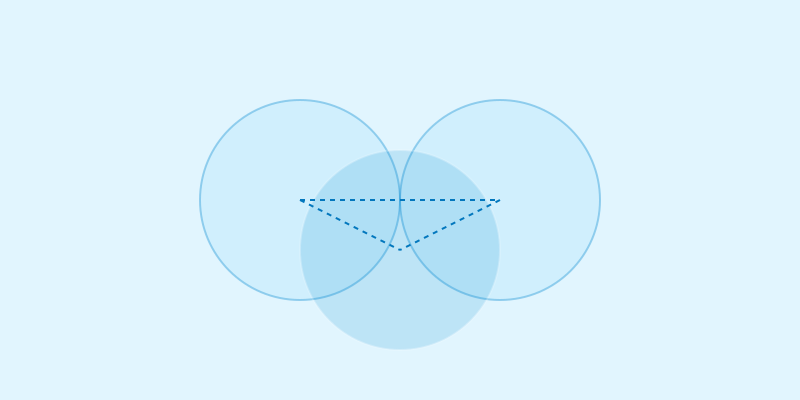
The "Vee" is the most basic unit of polyamory involving three people. Imagine the letter V. The person at the bottom point is the "Hinge." The two people at the top points are the "Arms." The Hinge is dating both Arms, but the Arms are not dating each other.
This is extremely common. The Arms are considered "Metamours" (partners' partners). They might be friends, acquaintances, or complete strangers, depending on the comfort level of everyone involved. The key to a healthy Vee is ensuring the Hinge manages their time and affection equitably (though not necessarily equally) between partners.
2. The Triad (Throuple)
A Triad is a relationship where three people are all dating each other. Geometrically, this is a triangle where every point is connected to every other point. Triads are often romanticized as the "ideal" polyamorous setup, but they are incredibly complex to maintain.
In a Triad, there are four relationships happening simultaneously: A+B, B+C, A+C, and A+B+C. If one dyad (two-person pair) breaks up, it can destabilize the entire structure. For more on the specific challenges of Triads, see our Unicorn Lifestyle Guide.
3. The Quad
A Quad involves four people connected in various ways. A common form is two couples who date each other (swapping partners or group dating). Another form is a "W" structure, where two Hinges are connected by a shared partner. Quads can offer a high level of stability and shared resources, often functioning like an extended family.
4. Solo Polyamory
Solo polyamorists reject the "relationship escalator"—the societal expectation that dating must lead to cohabitation, marriage, and shared finances. A solo poly person may have many deep, committed relationships, but they identify primarily as an independent unit. They are their own "primary partner."
This structure emphasizes autonomy and agency. It is a powerful rebuttal to the idea that being single is a "fail state" or a temporary condition. Solo poly people prioritize their own growth, career, and friendships just as highly as their romantic connections.
5. Hierarchical vs. Egalitarian Polyamory
Beyond the shapes, there is the question of power dynamics.
- Hierarchical: There is a clear ranking. A "Primary" partner (often a spouse) takes precedence over "Secondary" partners. Rules might dictate that the Primary relationship is protected at the expense of others (e.g., veto power).
- Egalitarian: All partners are considered equal in importance, though the relationships may look different logistically. No one has the power to control or end another's relationship.
6. Kitchen Table Polyamory vs. Parallel Polyamory
This distinction refers to how much interaction partners have with each other.
- Kitchen Table: Everyone is comfortable hanging out together. You could all sit around a kitchen table for breakfast. It emphasizes community and friendship among metamours.
- Parallel: Partners run on parallel tracks and rarely meet. The Hinge compartmentalizes their relationships. This is valid for those who prefer privacy or high autonomy.
Navigating Your Structure
The beauty of polyamory is its flexibility. You might start as a Vee and evolve into a Triad. You might begin with hierarchy and move toward egalitarianism as you become more secure. The most important tool is communication. Regular check-ins (RADARs) are crucial for ensuring everyone feels heard and valued.
Remember, there is no "superior" structure. The best structure is the one that works for the people in it. If you find yourself struggling with feelings of exclusion or competition within your chosen structure, revisit our guide on Overcoming Jealousy.
Support the Research
Direct funding ensures continued fidelity. Support the Cheating Psychology Research Initiative.
Support via PayPal